Stepping into the pine-panelled living room, we are encouraged to keep our wet boots on, despite our protests and the hosts wearing their handknitted socks. The small kitchen/living room/dining room is cosy, heated by a wood-fed oven. At one end of a sofa sits Milka, the matriarch, her white hair covered by a blue headscarf; her son, Gojko, smokes roll-ups at the other end. Jesus stares out benevolently from a wall calendar. Gojko’s wife, Milena, quickly covers the small table with plates of handcured meat, slabs of freshly made cheese curds, thick slices of warm homemade bread, shots of punchy, clear rakija (grappa) and tall glasses of fuchsia-pink pomegranate juice.
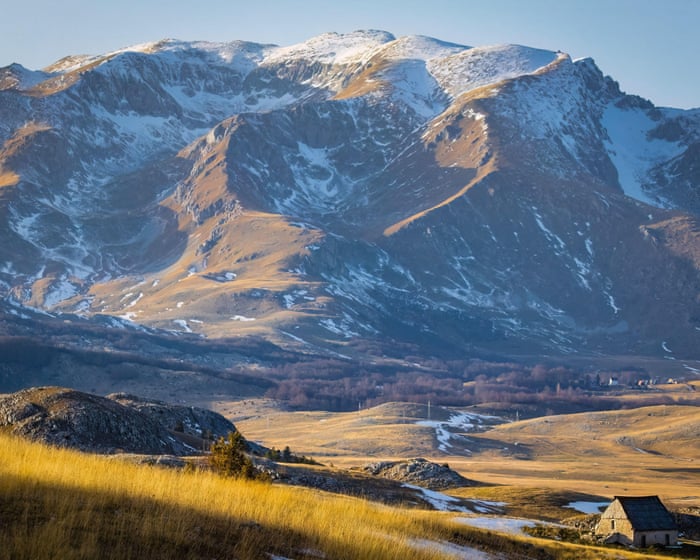
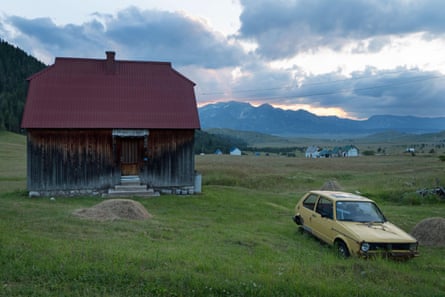
We are enjoying this traditional farmhouse lunch in the rural hamlet of Kovčica, a few miles from the small town of Žabljak, in the north of Montenegro, 30 minutes from the borders of Serbia to the east and Bosnia and Herzegovina to the west. Beyond the windows is an austere expanse of snowy wilderness; it could be the hinterlands of the Scottish Highlands if not for the rusting Lada off-roader, the scattering of houses with sharply pitched corrugated iron roofs, and the vast snow-covered limestone massif peaks of the Dinaric Alps beyond.
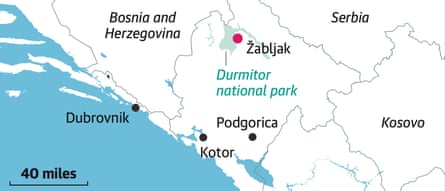
Montenegro (literally black mountain) is the second smallest country in the Balkans after Kosovo, roughly the size of Wales and with a population of about 623,000. It is a nation of two halves. The pampered southern half, with its deep-blue Bay of Kotor on the sun-drenched Adriatic, two hours from its glamorous Croatian cousin, Dubrovnik. And up here, the northern reaches, where tourism is yet to catch up. It is two decades since Montenegro voted for independence from Serbia, marking the final chapter in the breakup of Yugoslavia. I am travelling with a friend, both of us steadfast anti-skiers seeking a few days enveloped by the stark beauty of snowy mountainscapes without the hordes of skiers shredding across the Alps. We want an alternative icy adventure for a few days, somewhere quiet, more affordable.
After gorging on Milena’s handmade pita sa sirom – similar to Greek spanakopita but filled with an oozing unripened fresh cheese – we return to Žabljak squashed in the back of Milena and Gojko’s Lada. Just two hours north of the capital, Podgorica, this tranquil one-street town is the gateway to the Unesco-protected wilderness of Durmitor national park.
Its 18 glacial lakes and 120 soaring peaks – nearly 50 of them over 2,000m – are set inside 390 sq km (150 sq miles) of parkland, with the drama of Tara Canyon – one of the deepest in the world – carving through it all. We take a 4x4 safari up to the canyon’s dizzying heights. Home to wolves, brown bears, chamois, golden eagles, peregrine falcons and capercaillie, with 25 well-marked trails, the park is a haven for hikers and cyclists in warmer months, but in winter the snow is deep, with 2-metre drifts pushed either side of the ice-clad road. We are following the Durmitor Ring, a panoramic road winding around the park in a loop, climbing up to 1,950m. The snaking Tara River, popular with rafters in summer, lies far below. After a couple of heart-stopping three-point turns, we head down, passing a few unfazed locals as we do.
We sleep deeply at Casa di Pino, our eco-lodge on a quiet backstreet in Žabljak. Like most buildings here it has a well-stacked woodpile outside, a sauna inside and a constant toasty fire. At breakfast the next day, we feast on pine needle honey, thick bitter coffee, plates of boiled eggs, meats, cheese pies, fruit jams and fresh yoghurt before hitting the trails, snowshoeing beneath the peaks.
Strahinja, a volunteer in the mountain rescue team, has been guiding since he was a child, when he ventured out with his father, also a guide. He leads us on trails under dense canopies of spruce, pine and beech, dripping with thick moss and snow. The only sounds are of our breathing and crepitating footsteps as they push against the deep drifts seasoned liberally with pine needles.
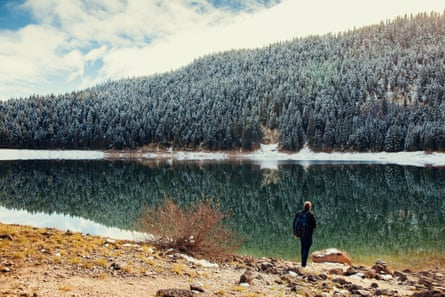
There is nothing and no one around as we finally reach Zminje Lake, a perfect frozen teardrop of white, wreathed with dense emerald woods. “This is packed out in the summer,” says Strahinja. “People come to picnic, swim and fish.” But right now, at the margins of winter, it is a halcyon spot to relax and share snacks.
We trek a further 3 miles, passing no other hikers as we head towards the vast Black Lake. It is busier here, mainly due to the timber-clad tavern next to the car park serving grilled lake trout and white wine from Plantaže, a vineyard a stone’s throw from the capital. After a long lunch, we walk back the few miles into town, passing snowmobiles and the start of the cross-country skiing trail, just 800 metres from Žabljak’s one ski rental centre.
Sadly, it’s time to leave the park, and we head south, winding down multiple hairpins away from the mountains, stopping at a roadside tavern for an ice-cold glass of Nikšićko, the national beer. Inside, a fug of cigarette smoke casts a soporific haze over the cold, dark afternoon. Cigarettes cost about €4 a pack, and the smoking culture takes us back to the 1990s.
Just two hours later, we roll into Kotor on the trajekt, a small ferry shuttling cars and passengers across the Bay of Kotor (often called Europe’s southernmost fjord) from Lepetane. Tucked deep within two protective inlets on the Adriatic, the Roman settlement turned walled city of Kotor was perfectly positioned to defend itself against plundering pirates and would-be invaders. Two millennia later, it is hulking cruise ships that lay siege. In summer, Kotor and the Montenegrin south are overwhelmed by tourism.
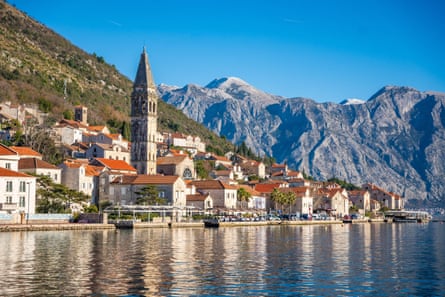
Across the bay, the recently opened Hyatt, a gleaming, marble-clad five-star behemoth, shimmers in the late evening sunlight, an indulgent conclusion to our icy mountain trails.
But for us, it isn’t the Hyatt or the drifting cruise liners that define Montenegro. It’s the woodsmoke, frozen lakes, the people, shots of rakija and the tiny hamlets dotted inside Durmitor that form its character. Long after the hairpins have levelled out, it is that cosy pine-panelled farmhouse in the north and the hosts’ hospitality that stays with us most.
The trip was hosted by the National Tourism Organisation of Montenegro in partnership with the local tourism organisations of Žabljak, Kotor, Cetinje and Winery Šipčanik. Accommodation was provided by Hyatt Regency Kotor Bay (doubles from €126) and Casa di Pino (doubles from €85). Brajović Travel organised the rural household visit and trekking